
Bee Michael’s Soldato Interview
**This interview and book contains strong language which may not agree with all readers. Please click [here] to view the NFRTG content warning page, if this is a concern. If you are scared of words, you have been warned.
Fueled by a chronic fascination as an adolescent with the undeniable authenticity and unlikely community-building found on shock sites, which matured into an investigative infatuation with those same sites as an adult, Bee Michael’s debut publication NEWFAG RUNS THE GAUNTLET captures, in all their glory, corners of the internet others dare not even acknowledge. An extreme horror and splatterpunk author, Michael’s self-published debut novel NFRTG offers the reader a look into edgelord internet culture, what it means to be a person, and the power of friendship.
Micheal will be coming to Soldato on November 21st from 2-4pm for ‘Live In The Meatspace,’ a conversation with Michael about xir inspirations while writing, the sorrows and triumphs of self-publishing, and all things internet (and not-internet) culture!! Keep reading to find out more, you sicko.
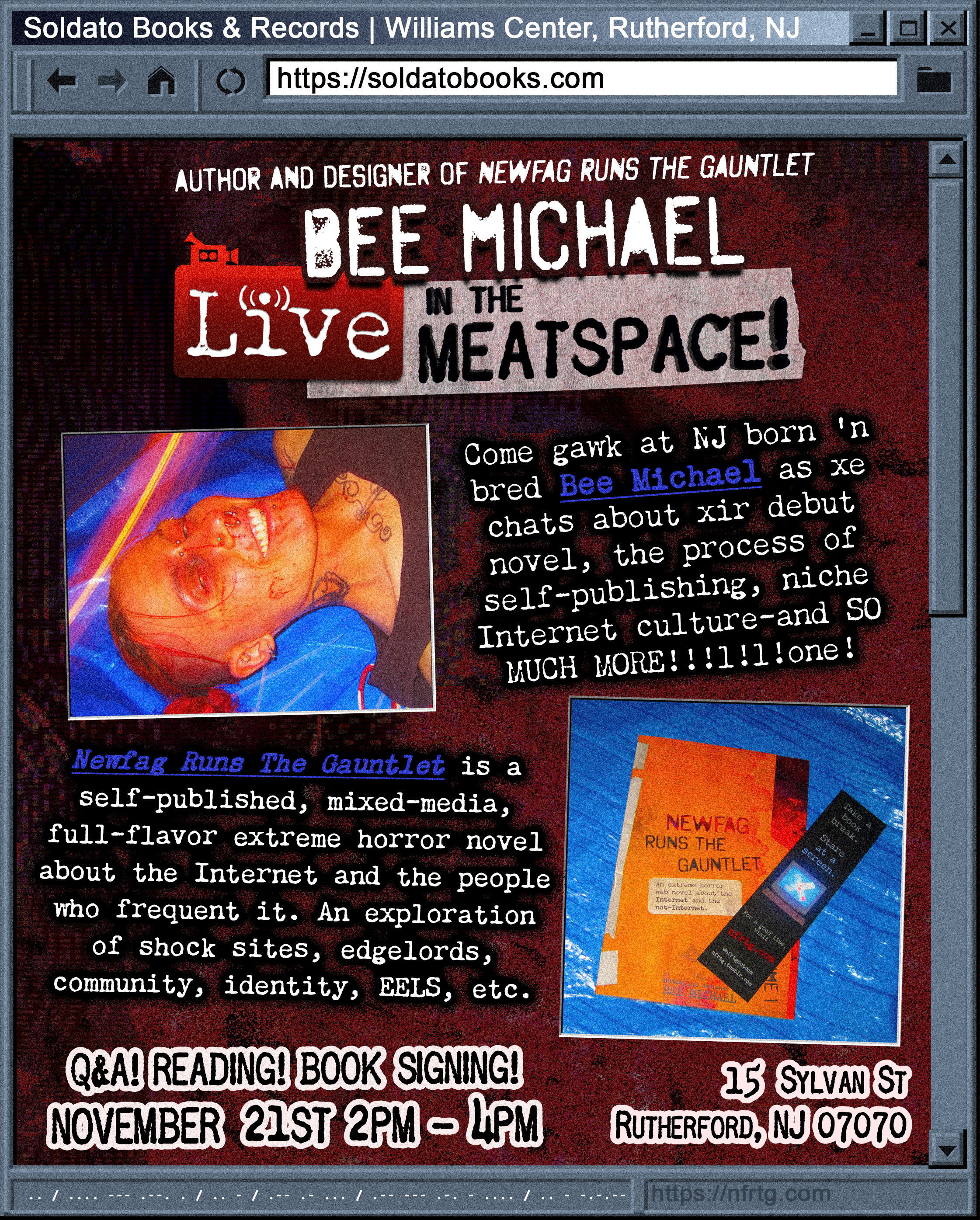
**Event Poster created by Bee Michael
Despite being fictional, NEWFAG RUNS THE GAUNTLET does not pull its punches when it comes to engaging with sides of the internet that most people would rather just allow to sit in darkness unacknowledged. So, what about this part of the internet, and the human psyche, interests you?
I grew up chronically online, still am, and this corner of the internet was really alluring to me at a time when I was, yes, an angsty teenager, but also really lonely. At the culmination of this sect of the internet it was like this place where people were speaking super freely; so, it was a perfect place for a young teenager who was trying to rebel and who didn't have a lot of friends-- that was me. I was really drawn to that.
I’ve distanced myself from all of that and [said,] “I'm never going back there.” Then, with enough time to heal from it, I started realizing in my late 20s [that as] terrible as it may have been, it was formative. Whether or not I want to take that with me, it is with me. Some of the most important years of my life in terms of finding myself revolved around this garbage. I can't erase that or deny that-- maybe I just want to look at it. That's kind of like a central theme in the book and with Newfag as a character, he would rather absolutely drown himself in something than shy away from it. That's my tactic with everything.
While you distanced yourself from that world, NFRTG does show how there is a sort of that catharsis with seeing that there are other people that like this, too.
Yes. [Knowing] there are other people that are going through this when in my everyday life people think I'm crazy for normal things-- so, what if I actually did look at bad things or was the bad person? I think it’s really weird [but] kind of makes sense that there's this community that comes out of it.
Why do you think creating communities online has become so popular?
I love that you use the word community because when I pitch [NFRTG] to people I say it's about community and they say, “What the fuck are you talking about?” But it is! That was my community and that is their communities. Yeah, it's fucked up, but it's all we had. We're finally at an age now where we can look back and be really observant. We're finally the first generation to now be adults who spent the majority of their lives on the internet to such an extent that the majority of us formed online communities.
We didn't know about the internet, the internet was the Wild West. There was so much that wasn't regulated. So, even if that wasn't like your neck of the woods, there was a period of time where we were just seeing crazy shit on the internet. And we never got to process that, I don't think, because it moved so fast. The internet is scary and it's scary now in a different way.
Let me just speak on that.
Please.
This is something that really bothers me [while] talking about the internet-- the differentiation between the internet and real life. I hate that, I hate using real life, which is why the tagline is the internet and the not-internet. I don't think that's fair [because] there are still consequences for things that you say and do on the internet. It still very much does apply to your real life. I think it's funny that instead of devaluing the credibility and the authenticity of the internet, it’s just not-the-internet. I try really hard not to separate the online component of Newfag from the physical aspect.
Remember when it was all for the love of the game?
The idea of monetization is like… we have to do it, this is where we are. When I first started writing this, [I said,] “I don't want to make money off of this. I want this to be a passion project.” Now, you know, this is a second job for me, [but] if I was writing this in the period in which it takes place in 2011, I could just throw it out there and it would be completely different.
Do you know Blowfly Girl?
Yeah. Of course. That's my queen, by the way.
Something about [her] really shook me because I think about how things used to be so impermanent, you used to think nothing could get traced back to you. You really just got to be like yourself, for better or for worse.
I think Blowfly Girl is like a perfect example of that. That passion for anything and everything can't [exist] in the same way because of the way that everything is so connected with digital footprints and stuff. We are in such an age now where that is something that we have to consider in order to be employed and have a stable life, and that's bullshit.
I think that whenever people ask questions in this vein, it easily gets to be so Puritan, but I am curious what goes into making something so subversive like this? How do you deal with that vulnerability?
I wasn't prepared to have to do that at all. When I first started writing this it was purely online, purely for the love of the game. I was advertising it exclusively on Tumblr, so the people who were reading it were the people it was written for. I never really breached containment until the physical copy came out. I am not quiet about the fact that Newfag is a self-insert-- not presently, but you know at one point in time. There is so much of me in this little book [and it] is scary because it's so unknown to so many people.
You know, we keep talking about discomfort and leaning into it or shying away from it-- I really lean into it. When I experienced people saying, “this was fucking weird” or, “you're very weird for having written this,” it doesn't get to me. Not that the goal is to make people faint and throw up, that is really not why I write splatter and like extreme horror and stuff, it's just like a means.
What would you like readers to take away from reading NEWFAG RUNS THE GAUNTLET?
Be nice. Be nice and don't kill yourself.
Put that on everything. Tattoo it.
The dedication page says never kill yourself and I do mean that because I don't think people should. Even if that feels really stupid [to say,] as bleak as this can be, I always really like hearing that. It resonated with people in a very human way-- and humanity is [maybe] the biggest theme of the entire thing. What it means to be human.
My goal with this is not to necessarily dwell on, fixate on, punish oneself for really terrible things that we've done in the past. Obviously some things are worse than others and we have to come to grips with that and, you know, move through the motions of that; also, you can go through all of those motions and the people on the receiving end will still be hurt forever, and you can't do anything about that. It's what you do next that matters most. There are examples of characters in here who are trying to do a better thing with their next steps, and then there are people like Newfag who are just following in the same path that he was before. We can't undo shit and we can't unhurt people, but I hope that, at least for ourselves, we can choose to better ourselves and choose a more human path forward.
Question mark. Question mark. Period. Exclamation point. Question mark.
Wow.
Yeah. And that's all of them.
Anything that I didn't ask that you want to say?
Fuck.
My big vague, open-ended one.
Musical and literary inspirations! Musical theater has inspired me so much-- which feels really silly in this respect. I think what it comes down to more is unconventional ways of portraying stories and telling narratives. Musicals are an unconventional method of storytelling in that way. I always say that William Finn is a big writing inspiration because he just kind of wrote shit. He just had it.
I just think I just love to find inspiration in weird shit. Obviously I read horror, and I think, “whoa, cool, yeah. I'm inspired. Whoa. Cool.” But I think it's even more juicy to find the most obscure, random bullshit. Like, I love realtor tour listings for houses.
Like Zillow?
Yeah, I love niche ones. I follow so many accounts that just post photos. [It shows] just how unassuming things can be poignant to random people. I am definitely just a very sentimental person. Very easily affected by anything.
The first time I came to the Williams Center as an adult person, I thought, “I've been here before, and I don't know how or when, but I've been here before.” I went into the big old main space [the Rivoli] down there and I used to have my dance recitals here. I freaked the fuck out. So, the Williams Center is one of those places to me where I just feel so strongly, and now I feel that way every time I get off the bus and I walk over here! I love places and I love the Williams Center and William Finn.
So many Williams.
So many Williams.
Interview conducted and edited by Mia Guzzo