
Daniel Dobrygrowski's Soldato Interview
With the recent onslaught of everyday Artificial Intelligence use, many are slow to trust businesses pushing the use of this new technology. Having worked as an attorney in cybersecurity for over 20 years, Daniel Dobrygowski, with his book Technological Governance: Build Trust in Digital Innovation, delves into why we may feel this way and how to demand better for ourselves, along with frameworks for businesses to actually build trust regarding their AI innovations.
Dobrygrowski will be coming to Soldato on November 12th from 6:30-8:30pm to discuss the principles from this book and how everyday people are able to change the technological landscape. Keep reading to learn more about the work he is doing to empower everyday people and promote a more fair use of technology.
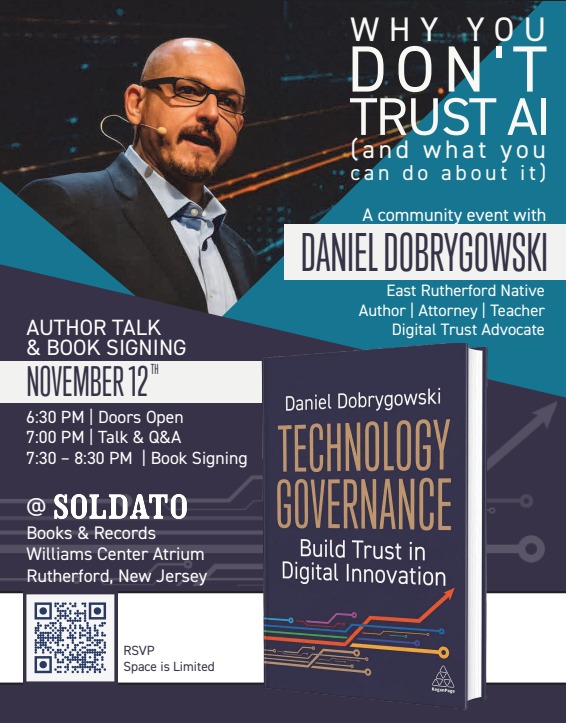
**Event Poster created by Tiffany Dobrygrowski
What inspired your interest or concern in [artificial intelligence] before the boom of everyday use of AI we have now?
I've been working as an attorney in technology governance and privacy, consumer protection, cybersecurity, for over 20 years. In that work, I've seen where companies fall short of what our expectations are around these technologies. What I wanted to do was figure out a way that I can bring together these different threads so organizations using technology can do better for people and for themselves as companies.
My goal has been to help understand how we can make access to technology-- use of technology, impact of technology-- more fair and more protective of regular folks. I've been in the rooms of people making these decisions, and I'm always the voice asking what we are doing for regular people. How are we protecting privacy? How are we ensuring security of their data? And then how are we making sure that they not only get the skills they need, but the choice in how they're using this tech?
If people may not even be trusting the people behind these technologies, how can we then build that trust with the businesses? What does that framework look like?
The way you trust a company using AI, or any other technology, is that they prove to you that what they're doing is in your interest or fits your expectations. That's one of the things I talk about in the book: that, ultimately, trustworthiness in tech is something you prove continually, and it's something that you earn from the people who are using the technology. Then the question arises, how do you prove that? How do you earn it? You prove it through a variety of different ways. Protecting people's privacy is one of the proof points, making sure you're building something that works in a way people expect it to work is another.
The reason you're seeing a lot of unrest and concern around AI [is because] another proof point is how fair it looks-- how much you're weighing the harms and the benefits. It's not helpful when a big AI company CEO will say, "Well, some people have to accept the harms that come from new technologies," because he's not accepting them. He's saying you all have to accept it, and that's not fair. That's ultimately where trust breaks down.
It feels like technological [innovation] now is just coming so quickly and if you don’t hop onto the wave, you just get caught under it. How do you think that people can avoid getting caught up in all of the overwhelm of all these new things?
This is a problem that everyday people who aren't involved in technology feel, but it's also a problem that people trying to build this technology feel. Part of it is you need something human that grounds you, otherwise, you do get caught up in all the hype. You [have to] get back to: what's the point of the technology? The point is to help human beings do something better, faster, easier. If you keep that as your North Star, then you know which technologies you need to use or not use and how.
We get involved in the tech because it's interesting and it is exciting, but the way you ensure that technology is deployed successfully is to think about the humans that are actually going to use it.
I often think in a marketing and PR sense, so, do you kind of think that the image of AI can be redeemed?
I think public perception can change. I think if PR was gonna solve it, it would have [already.] There's so much money being thrown at PR around AI, but you have a bunch of loose cannons running the industry, so it's not helpful. I imagine their PR people hate this, it's not helpful that someone in the same statement says, like, "AI is the best thing that's ever gonna happen to the human race, and also it's gonna kill us all." Right? That's not helpful for PR or for trust. We're at the point where better behavior is the solution-- you can't keep promising me that things are gonna get better without actually trying.
You get snaps from me for that one.
May the record reflect there was snapping of fingers.
Don't worry, it's on the record. Additionally, what would you like readers to take away from Technology Governance?
There's two things. One is that technology changes, but trust always matters. hat's where everybody's voice is most important because you have the power to give or deny your trust. You have the power to take up these technologies or leave 'em. It doesn't feel that way all the time, but you do. I'd also like readers to look at the book and say, "Here's, here's why I feel uncomfortable about where we are in the current world of technology. Here's what's happened in the past, this isn't the first time we've gone through this, and here's where my power is. Here's where I can hold everything from the local business to the biggest hyperscaler accountable." We deserve that.
Technology changes, but trust always matters. There are important things that are happening right now to hold these companies accountable in a way that hasn't been true in the past. The state of regulation for tech is in a weird place, but just because there's no regulation doesn't mean there's no accountability. So, we're seeing that happen in lawsuits, in boycotts, in protests, in political movements against data centers and others. People have tremendous power, more than they think, to determine what their technological future looks like, and that's what I'd like people to think about with this book.
Is there anything else you would like to share?
Part of this whole thing is to think about [issues like emerging tech] as a community-- don't lose that sense. I think the advent of social media has kind of exacerbated this problem we have of atomizing as people and separating. The ability to come together is really important in this. That's a long way of saying you should support things like your local bookstore, the Williams Center, and places like that because that's where we come together as a community.
The other thing is [that] I want to recognize that it is a worrisome time. People worry about their jobs, they worry about technological innovation, they're worried about new technologies taking away their jobs and changing their way of life. As human beings, we've been there before. Sometimes it hasn't gone well for the majority of people, sometimes it has; we should do what we can to try to make this a good story, right? We have that power, we can do that.
Interview conducted and edited by Mia Guzzo