
J.T. Trigonis’ Soldato Interview
J.T. Trigonis has been a staple of the poetry scene in New Jersey since the ‘90s, and now he is coming to Soldato to read from his newest publication— his debut chapbook, Through the Wreckage. Read Soldato’s interview with Trigonis to learn more about the wreckage he got through in this publication, his connection with the artistic community, and his advice for writers!
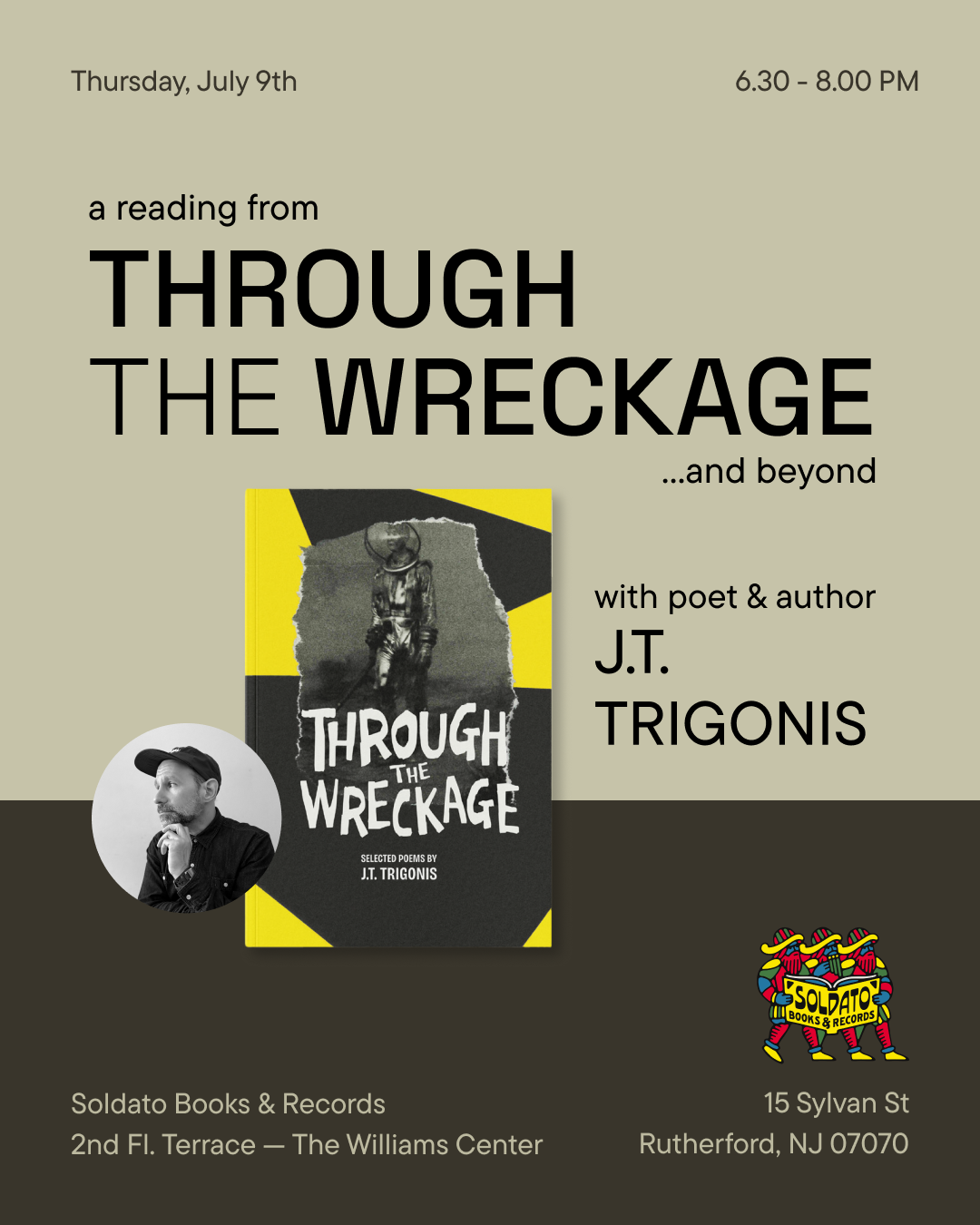
**Event Poster submitted by J.T. Trigonis
Could you introduce yourself to readers who may just be discovering your work?
I am John T. Trigonis, John Trigonis, and Trig to my close friends. I'm the writer of Through the Wreckage, which is my first book of selected poetry. Selected [meaning] that I chose all the things that I consider, and that people have told me are, bangers. I've done about eight self-published chapbooks throughout my 25, 30 years doing this-- this was the first one that was not self-published. I've also been a staple of the open mic poetry scene in New York, New Jersey, specifically Hudson County since the '90s.
You said that this is your first formally published book. What was different about putting this together versus the other chapbooks that you have published previously?
My other books that I put together were just whatever I was writing that was new; every single poem in Through the Wreckage is its own thing. That comes with its own challenges: organizing [the poems,] putting them in the right order to make sure people don't get too much of one theme and then not enough of this. Even the best poets have filler and, instead of making a book with filler, I'd rather do chapbooks with 16 to 20 poems that just hit.
How would you describe this chapbook, Through the Wreckage?
It's old. I think the first time “Old ‘89” was published was 2001. Some of the ideas of the time when I was writing it were: cars, broken hearts, and stuff that I would consider sort of trite nowadays, but it’s heavy when you're experiencing it. It's really a collection that shows me getting over breakups and being a real asshole for whatever reason-- but, also a thoughtful one, you know? A person who's thinking about: how can I be better?
Also, a lot of diners. Very Jersey. If I had to describe it: it's a very Jersey collection. I don't ever want poetry, mine or anybody's, to be this esoteric shit that only a select group of people can understand. That's not a poem, that's not enjoyable. [Instead,] here's a hamburger reference and how I got into a car accident and here's a reframed line of a song that you may or may not remember.
What were some themes that shaped the writing of this collection?
Nostalgia is one. There's a bunch of fucked up love poems-- like a really crazy Tom Waits type album that you play and just can’t get enough of because you've been there-- and you want to go back, but you don't want to go back because it was such a bad time. It was so bad it was good. A little bit of everything, but love and trying to get on the other side of the wreckage of a life misplaced [especially.]
Was writing this chapbook like a healing process? Is there anything that you discovered about yourself while putting it together or writing these?
In the writing of them, I was sort of getting over a really bad breakup. I had gotten through that because I had written like a whole chapbook of stuff that kinda took care of that, but there was something that was lingering. I thought that you never truly move on, you just move past. In putting Through the Wreckage together, I realized, “Oh, you can completely move on now,” [because] these poems feel like stories from another life.
Soldato is a book and record store in an art center, so we definitely understand how important it is for artists to have their own artistic inspirations. Who are some musical, literary, or any other artists that inspired you in writing this?
Yeah, I love that question. The big one for this particular collection is Tom Waits, for sure. He's been inspirational ever since I saw him on David Letterman way back during his Real Gone tour. I was like, "Who the fuck is that?" My dad didn't even know what to make of it, but I was so enthralled by that raspy voice, the look. I honestly think he's a poet first above anything else. A little bit of Leonard Cohen. Basically, the two guys I have in my quotes at the beginning.
Do you wanna talk a bit about your store, as well?
I run a vintage shop/used bookstore called ‘Sure Things’ in good old Jersey City Heights-- best neighborhood in Jersey City. I've been doing that with my partner for five years this October. We have the ‘By The Way Magazine,’ which is a magazine of poetry and visual art, and it is made possible from a grant from the Jersey City Arts and Culture Trust Fund.
We've been running an open mic series we run called WAYE, standing for: We Appreciate Your Enthusiasm, which is, of course, the infamous first line of every rejection letter you've ever gotten. We run that every last Wednesday of the month. It's nice to be able to own a shop and not be so capitalistically minded [with the open mics,] where you don’t have anyone saying, "Well, this isn't really worth the time. I'm losing money with the electric bill." We do this for the sake of hearing each other and being in community together.
You're going to be having an event at Soldato on July 9th from 6:30 to 8:00 PM. Would you like to share for readers what this event will entail?
Yeah, I'm gonna read some shit. Some stuff from Through the Wreckage, but I'm also going to read some more modern contemporary stuff that I've been writing. I know the point of these things is to read from the book to sell the book, but, again, [I’m] not capitalistically minded. I'm going to read a few from the book and then I’ll just read because I love to read. It'll be a journey; from Through the Wreckage into the new wreckage, because the country's a fucking wreck. So, we're going to just be going from one wreckage to the next and then hopefully get through it.
What about this space and community at Soldato made you interested in having an event here?
It feels like a nice home. Books, records, music in general are very important to me, it's always been important to me, and Soldato is all of those things combined. The fact, too, that the Williams Center also has an underground theater cinema and I used to be an independent filmmaker for 10 years. It's got all the arts in this one building that means a lot to me. It's really special to be doing this.
What would you like readers to take away from reading Through the Wreckage?
One thing is [how] we all go through the same stuff. You may not know some of the references in these poems, but I'm hoping that I did my job as a poet well enough where you feel it. You'll get a sense of the loss, the brokenheartedness, the nostalgia. It doesn't have to be my nostalgia-- it can be yours. People would sometimes ask me, "What does this poem mean?" and I would just put the question back to them because I know what I got out of it, but that’s not the point. You know, I did my part. What did you get? They would tell me and even though it's very unique to them, I get it. I can see it. At the end of the day, it's just a book of poems about a moment in time that's no longer that moment. It's frozen and it's in the past-- it could be my past or your past.
Two is: if you're a fellow writer and a poet, you're never too old to get your first official book published. I used to say, "I'm gonna self-publish, and I'll staple it by myself and hand them out for free because fuck capitalism." I gotta say, it's kinda nice to get paid for a book of your poetry and have money for coffee because somebody bought your art. I don't regret giving away hundreds of copies of my handmade chapbooks to people who just needed poetry [but] back in the '90s and very early 2000s, you weren't paying for poetry from a no-name poet. Nowadays, it's so different. It's just such a different time and such a different appreciation for people's fucking souls. That's what I tell everybody: just publish. Put your shit out there. Get it out there, whether it's one poem or whether it's a chapbook or a full-length book. Just put yourself out there and try to get over the inhibitions or, in my case, the ignorance of just being too hard-headed.
Interview conducted and edited by Mia Guzzo